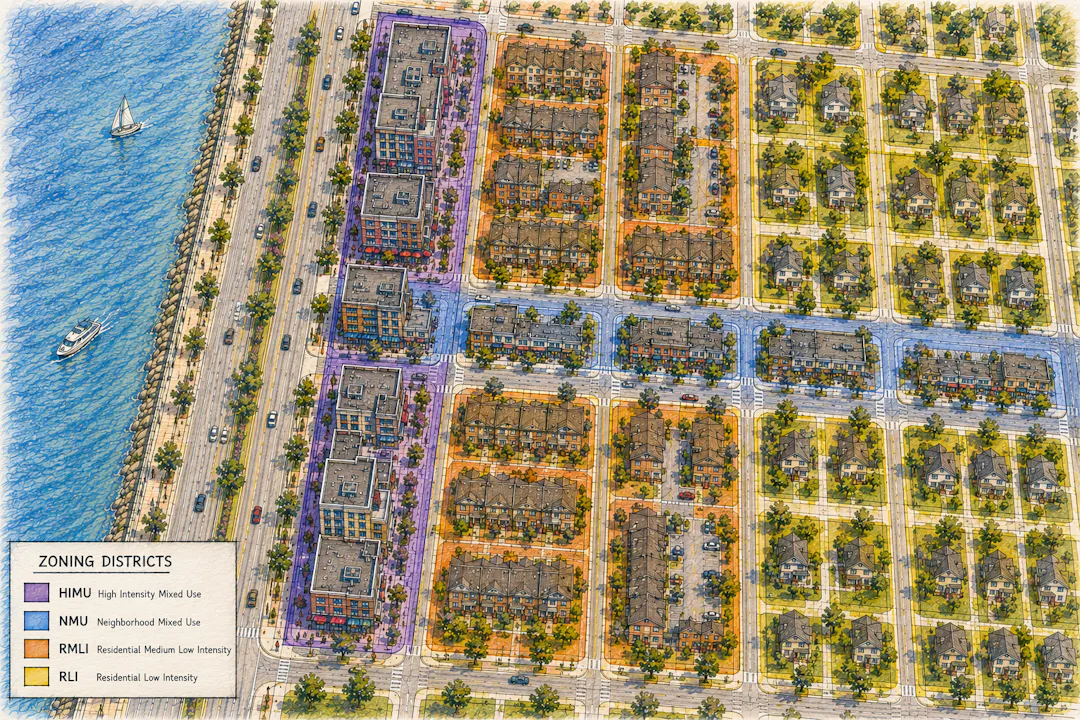
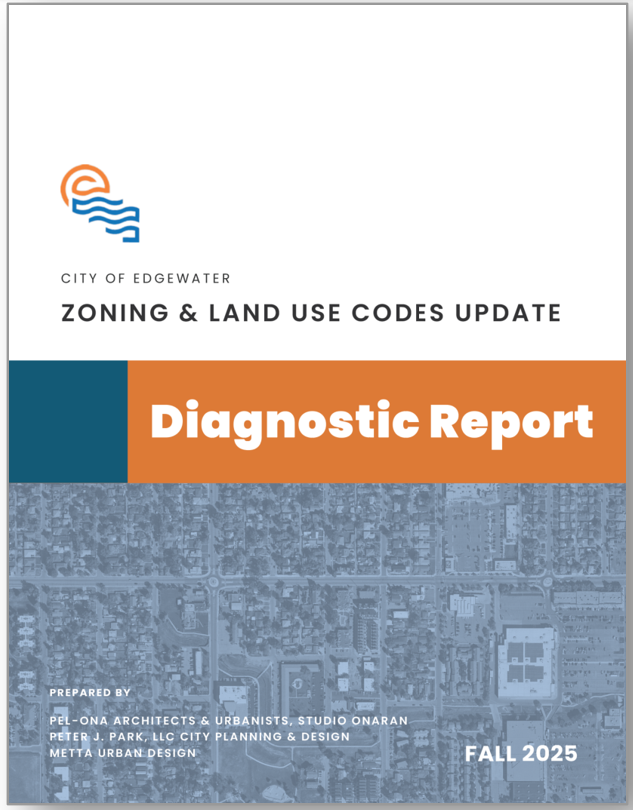
On Thursday May 7th, 2026 the City conducted the first gathering of the Zoning Code Update Technical Focus Group (TFG). The meeting focused on discussion of key themes emerging from the Diagnostic Report, Intensification Guide, and draft zoning framework concepts. The presentation can be viewed here: TFG Presentation #1. The content below primarily summarizes the feedback, concerns, and questions raised by participants during the discussion.
The meeting included representatives from the Planning and Zoning Commission, City Council, Sustainability Board, Historic, Arts, Recreation and Parks Board, Edgewater Renewal Authority, and members of the development community. Staff and consultant representatives facilitated discussion regarding neighborhood character, housing diversity, intensification strategies, code usability, and implementation challenges associated with state legislation and the Edgewater 2040 Comprehensive Plan.
Key Themes and Feedback
A substantial portion of the discussion focused on balancing neighborhood character preservation with the need to accommodate additional housing and comply with state legislation. Participants generally acknowledged that Edgewater’s historic development pattern—characterized by smaller homes on relatively large lots—forms a significant component of the community’s identity and “village in the city” character. There was broad recognition that recent redevelopment trends toward substantially larger homes have altered neighborhood scale without meaningfully increasing housing diversity or affordability.
Several participants expressed support for the emerging approach of encouraging smaller-scale housing forms, including ADUs, cottage clusters, and other “missing middle” housing prototypes, as a method of accommodating additional housing while maintaining neighborhood scale. Participants noted that promoting smaller units may align better with current market realities and affordability needs than continuing patterns of large single-house redevelopment.
Discussion also emphasized the importance of maintaining ownership opportunities within future housing models. Participants highlighted that long-term community stability and wealth-building opportunities are tied not only to rental housing availability, but also to attainable ownership products. The group discussed how cottage cluster and small-lot ownership models may provide alternatives to traditional single-family housing while preserving community character.
The group also discussed the challenges associated with preservation incentives and redevelopment pressures. While participants generally supported incentivizing preservation of older structures where feasible, there was acknowledgment that many existing homes were not originally constructed for long-term durability and that replacement of some structures will inevitably occur over time. The discussion emphasized the need for zoning regulations that encourage context-sensitive redevelopment rather than attempting to fully prohibit change.
Questions and Discussion Topics Raised
Participants raised several technical and policy questions throughout the meeting, including:
- How revised zoning regulations would address existing lot size irregularities and common 25-foot and 50-foot lot configurations;
- The feasibility and ownership structure of cottage cluster developments and whether units could be individually owned;
- Infrastructure considerations associated with increasing ADU intensity, including sewer capacity and service requirements;
- Concerns regarding luxury mixed-use development and whether future zoning incentives would effectively support attainable housing and small businesses;
- Potential height limitations within future mixed-use zoning districts; and
- Whether increased reliance on administrative approvals for certain project types may face resistance from the community.
Participants also discussed how parking requirements, financing structures, and construction defect laws continue to create barriers for smaller-scale and ownership-oriented housing products. Several attendees noted that reducing parking requirements and creating more predictable administrative review pathways may improve feasibility for smaller projects and local developers.
Process and Code Administration
The group generally agreed that the City’s existing development review process functions relatively efficiently compared to neighboring communities, but participants supported continued efforts to streamline regulations and improve predictability. Particular emphasis was placed on improving code usability by consolidating regulations, incorporating more graphics and visual examples, and reducing situations where applicants must navigate multiple code sections to understand basic development standards.
There was also discussion regarding the importance of community trust in administrative approvals and objective standards. Participants noted that clearer and more predictable regulations may help reduce unnecessary public hearing burdens while still maintaining alignment with community goals and adopted policy direction.
Next Steps
The next Technical Focus Group meeting is scheduled for June 8, 2026. That meeting is anticipated to focus on review and discussion of draft low density residential zoning districts and their associated development standards, including proposed dimensional standards, housing configurations, lot coverage, height, setbacks, and ADU provisions.
Staff will continue to provide summary updates to the Planning and Zoning Commission following each Technical Focus Group meeting as the rewrite process advances.
On Thursday May 7th, 2026 the City conducted the first gathering of the Zoning Code Update Technical Focus Group (TFG). The meeting focused on discussion of key themes emerging from the Diagnostic Report, Intensification Guide, and draft zoning framework concepts. The presentation can be viewed here: TFG Presentation #1. The content below primarily summarizes the feedback, concerns, and questions raised by participants during the discussion.
The meeting included representatives from the Planning and Zoning Commission, City Council, Sustainability Board, Historic, Arts, Recreation and Parks Board, Edgewater Renewal Authority, and members of the development community. Staff and consultant representatives facilitated discussion regarding neighborhood character, housing diversity, intensification strategies, code usability, and implementation challenges associated with state legislation and the Edgewater 2040 Comprehensive Plan.
Key Themes and Feedback
A substantial portion of the discussion focused on balancing neighborhood character preservation with the need to accommodate additional housing and comply with state legislation. Participants generally acknowledged that Edgewater’s historic development pattern—characterized by smaller homes on relatively large lots—forms a significant component of the community’s identity and “village in the city” character. There was broad recognition that recent redevelopment trends toward substantially larger homes have altered neighborhood scale without meaningfully increasing housing diversity or affordability.
Several participants expressed support for the emerging approach of encouraging smaller-scale housing forms, including ADUs, cottage clusters, and other “missing middle” housing prototypes, as a method of accommodating additional housing while maintaining neighborhood scale. Participants noted that promoting smaller units may align better with current market realities and affordability needs than continuing patterns of large single-house redevelopment.
Discussion also emphasized the importance of maintaining ownership opportunities within future housing models. Participants highlighted that long-term community stability and wealth-building opportunities are tied not only to rental housing availability, but also to attainable ownership products. The group discussed how cottage cluster and small-lot ownership models may provide alternatives to traditional single-family housing while preserving community character.
The group also discussed the challenges associated with preservation incentives and redevelopment pressures. While participants generally supported incentivizing preservation of older structures where feasible, there was acknowledgment that many existing homes were not originally constructed for long-term durability and that replacement of some structures will inevitably occur over time. The discussion emphasized the need for zoning regulations that encourage context-sensitive redevelopment rather than attempting to fully prohibit change.
Questions and Discussion Topics Raised
Participants raised several technical and policy questions throughout the meeting, including:
- How revised zoning regulations would address existing lot size irregularities and common 25-foot and 50-foot lot configurations;
- The feasibility and ownership structure of cottage cluster developments and whether units could be individually owned;
- Infrastructure considerations associated with increasing ADU intensity, including sewer capacity and service requirements;
- Concerns regarding luxury mixed-use development and whether future zoning incentives would effectively support attainable housing and small businesses;
- Potential height limitations within future mixed-use zoning districts; and
- Whether increased reliance on administrative approvals for certain project types may face resistance from the community.
Participants also discussed how parking requirements, financing structures, and construction defect laws continue to create barriers for smaller-scale and ownership-oriented housing products. Several attendees noted that reducing parking requirements and creating more predictable administrative review pathways may improve feasibility for smaller projects and local developers.
Process and Code Administration
The group generally agreed that the City’s existing development review process functions relatively efficiently compared to neighboring communities, but participants supported continued efforts to streamline regulations and improve predictability. Particular emphasis was placed on improving code usability by consolidating regulations, incorporating more graphics and visual examples, and reducing situations where applicants must navigate multiple code sections to understand basic development standards.
There was also discussion regarding the importance of community trust in administrative approvals and objective standards. Participants noted that clearer and more predictable regulations may help reduce unnecessary public hearing burdens while still maintaining alignment with community goals and adopted policy direction.
Next Steps
The next Technical Focus Group meeting is scheduled for June 8, 2026. That meeting is anticipated to focus on review and discussion of draft low density residential zoning districts and their associated development standards, including proposed dimensional standards, housing configurations, lot coverage, height, setbacks, and ADU provisions.
Staff will continue to provide summary updates to the Planning and Zoning Commission following each Technical Focus Group meeting as the rewrite process advances.